No. Bionic reading does not make you read faster or understand more. Four tests from 2022 to 2026 found no real gain. The biggest timed 2,074 readers. The newest, published on September 2, 2026, tracked the eyes of 90 adults and found no change in reading time or understanding (Royal Society Open Science). If it feels nicer to you, use it. Just do not expect a speed boost.
At a Glance
- Bionic reading bolds the start of each word to guide your eye
- A 2022 web test of 2,074 readers found people read 2.6 words a minute slower with it, which is no real difference
- A 2024 lab study titled its finding in five words. Bionic reading does not work
- A 2025 eye tracking study found reading took longer with it, on screen and on paper
- A 2026 eye tracking study found the bold moved where eyes landed, and nothing else changed
- In that study, plain text got the best readability score, and more readers picked it than either bolded style
- Readers with ADHD or dyslexia have not been tested well yet
What Bionic Reading Is
We built a speed reader, so we get asked about every reading trick going. Bionic reading is the one people ask about most.
The idea is simple. Bold the first part of each word. Your eye catches the bold part, your brain guesses the rest, and you move on faster. A Swiss company sells it under a registered trademark. Its site says the method is protected by patents, copyrights and trademarks, and that it offers a free version with paid upgrades. It lets you pick how much of each word gets bolded, which it calls the fixation (company site).
Here is what it looks like. Same sentence, two ways.
It looks fast. It feels fast to a lot of people. The question is whether a stopwatch agrees.
The Four Tests, Side by Side
Most pages on this topic quote one study from 2022 or a pile of forum posts. There are now four real tests. Here they are together.
| Test | Who read | How it was measured | What it found |
|---|---|---|---|
| Web experiment, July 2022 | 2,074 people finished, 1,916 kept after cleaning | Timed reading of two essays with quiz questions | No real change in speed or understanding |
| Snell, Acta Psychologica, 2024 | Adult readers | Reading time on 100 paragraphs | No significant difference |
| Možina and team, Sage Open, 2025 | Students and middle aged readers | Eye tracking on screen and paper, two fonts | Reading took longer with bionic. No gain on paper |
| Parker and team, Royal Society Open Science, 2026 | 90 skilled adults | Eye tracking, word and sentence times, comprehension | Eyes landed in a new spot. No gain in speed or understanding |
Four teams, four methods, one answer. Now the details.
Test One. 2,074 Readers on a Stopwatch
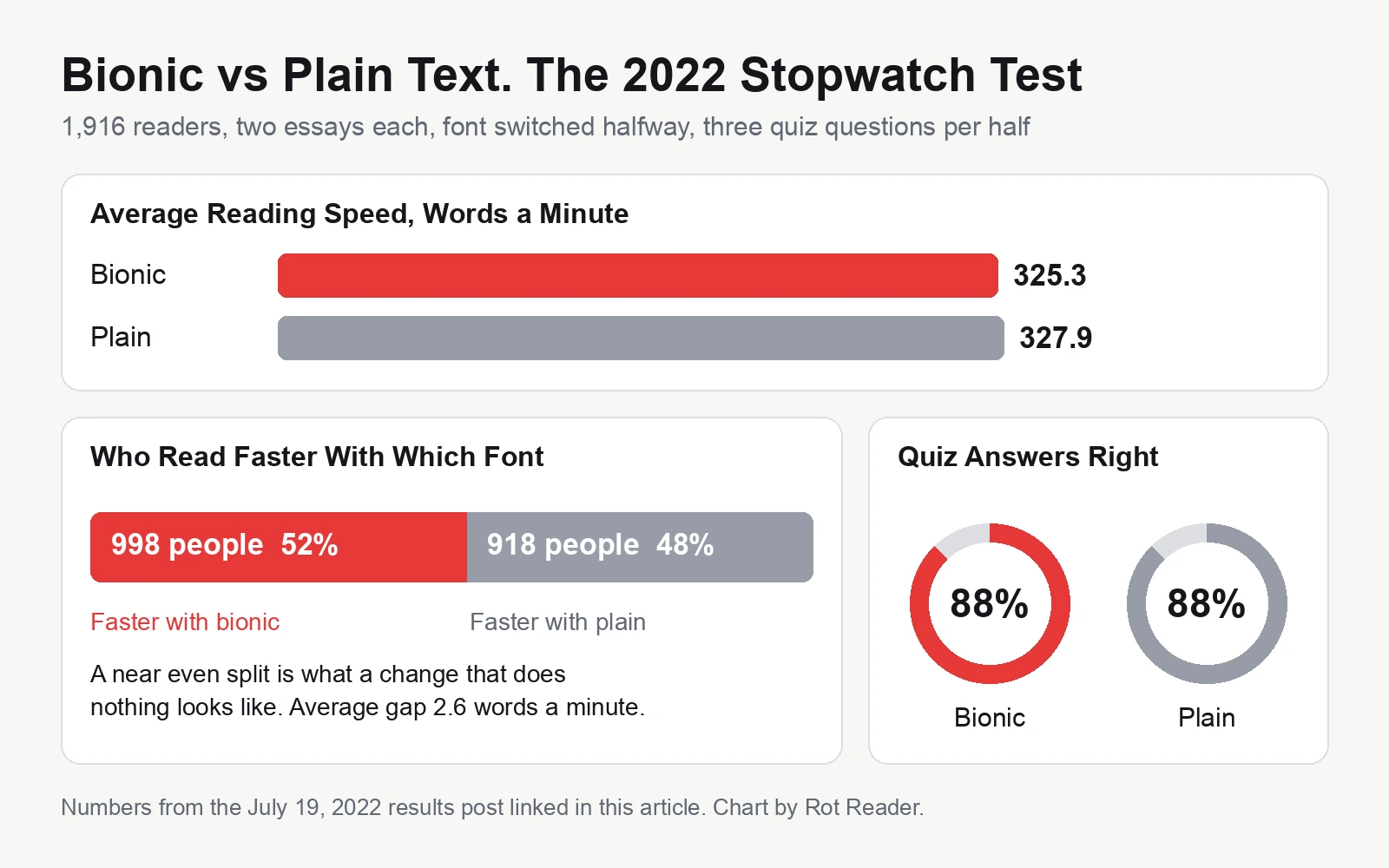
In June 2022 the makers of a reading app put a free test online and shared it on Hacker News, Reddit and Twitter. Each person read two essays of about 1,000 words, split into halves. The font switched between plain and bionic. After each half came three quiz questions.
On July 19, 2022 they posted the results. 3,334 people started and 2,074 finished. After removing duplicates and people who clicked through at over 2,000 words a minute, 1,916 were left (results post).
- Speed. 325.3 words a minute with bionic and 327.9 without. People read 2.6 words a minute slower with bionic on average. That gap is under 1 percent and was not statistically significant.
- Understanding. 88 percent of quiz answers were right with both fonts.
- The split. 998 people read faster with bionic, by 35 words a minute on average. 918 read faster without it, by 43 words a minute.
That last line is the one people misread. About half got faster with bionic. About half got faster without it. That is what you see when a change does nothing and people just vary from one passage to the next.
Test Two. A Lab Study With a Blunt Title
Joshua Snell of Vrije Universiteit Amsterdam ran a separate test and published it in Acta Psychologica in 2024. Readers went through 100 paragraphs, some in bionic and some in normal type. The analysis found no significant difference in reading times between the two. He titled the paper No, Bionic Reading does not work (university record).
A web test has noise. People get distracted, switch tabs, or read on a phone. This was a different setup with the same kind of question, and the answer stayed the same.
Test Three. Eye Tracking on Screen and Paper
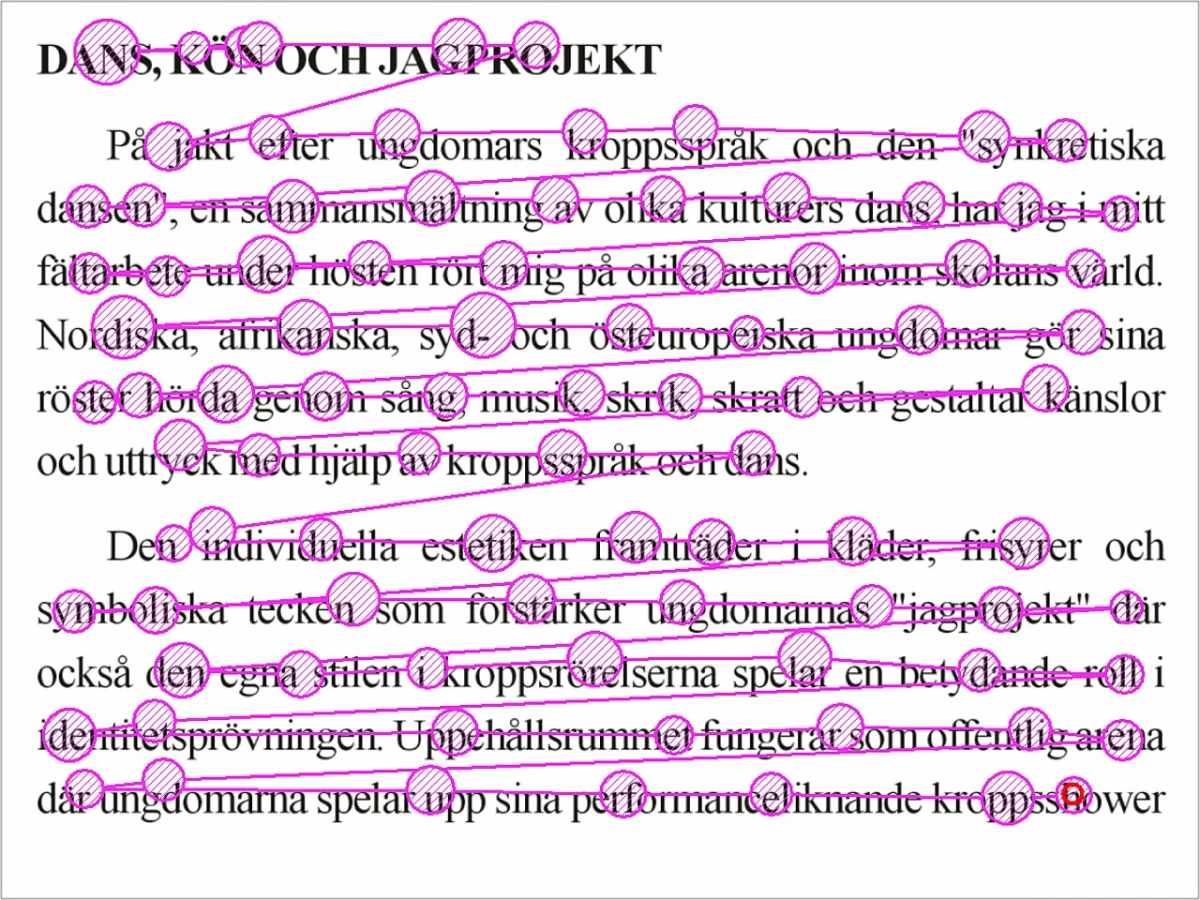
Klementina Možina, Dorotea Kovačević and Barbara Blaznik tested two groups, students and middle aged readers, with an eye tracker. They used two common screen fonts, Georgia and Verdana. They also printed bionic text on paper, since the method was made for screens.
Their paper came out in Sage Open in October 2025. The abstract says bionic reading made reading time longer. It found no advantage for bionic text on paper. Verdana read faster than Georgia either way. The older group read faster in every setup (Sage Open).
The authors stopped short of a final verdict, because the memory and understanding results did not all point the same way. They called for more testing, including with readers who have dyslexia or ADHD.
Test Four. The Newest and Most Careful
As of October 2026, this is the one almost no page on bionic reading covers yet. Adam Parker and Hyunjun Lee of University College London, Haibei Wang of Royal Holloway and Holly Joseph of the University of Reading published it on September 2, 2026 (Royal Society Open Science).
It was a registered report. That means the plan was reviewed and locked before any data came in, so the team could not shop for a good result. Here is what they did, as summed up by Science Blog on September 14, 2026 (Science Blog).
- 90 skilled adult readers, aged 18 to 40, read single sentences.
- An eye tracker recorded where each eye landed, 1,000 times a second.
- Text came three ways. Plain, start bolded like bionic, and a check version with the middle of each word bolded.
The bold did one thing. On long words, it pulled the eye's first landing spot back toward the start of the word. Then nothing else moved. The abstract reports no evidence of a difference in word skipping, word reading time, sentence reading time or comprehension (Royal Society Open Science). Comprehension sat near 95 percent in every version, per the Science Blog summary.
So bionic text does steer your eye. It just steers it to a spot that does not help.
Why It Feels Faster When It Is Not
Plenty of people swear bionic reading helps them. We believe they feel that. Here is why the feeling and the stopwatch can disagree.
- Taste is real, and it is personal. In the 2026 study, 31 of 90 readers picked the bolded text as easiest to read. But the study found that what people preferred did not predict how fast they read (Science Blog).
- Novelty grabs attention. A new look makes you pay attention for a while. Attention can feel like speed.
- Short tests lie. One timed paragraph swings a lot from one try to the next. That is why half the 2022 testers looked faster with bionic and half looked faster without it.
- Where your eye lands was not the bottleneck. The 2026 study moved the landing spot on long words, and reading time stayed the same.
Our take. As of October 2026, the top pages for this question are mostly forum threads and old blog posts that report how bionic reading felt to the writer. That is the weakest kind of evidence there is. Four timed tests beat a thousand feelings.
What About ADHD and Dyslexia?
This is where the honest answer is that nobody knows yet.
The 2026 study tested skilled adults with no reading problems, and the authors say their results do not carry over to people with dyslexia or other reading difficulties. The 2025 team asked for new tests with readers who have dyslexia and ADHD. The company's own site shows user stories from readers with dyslexia and ADHD, but it does not make medical claims.
The 2026 authors also point out that reading trouble likely comes from things like sounding out words and vocabulary. Bold letters are unlikely to fix those. So if you or your child struggle to read, bionic text is not a treatment. A reading specialist is.
If bionic text simply helps you stay on the page, keep using it. Staying focused has value even if it does not raise your speed.
Test It on Yourself in 15 Minutes
You do not have to trust us or the studies. Copy what the 2022 test did, at home.
- Pick two passages that match. Same author, same kind of writing, about 500 words each.
- Make one bionic. Use any free bionic converter on one passage. Leave the other plain.
- Time each one. Divide the word count by the minutes it took. That is your words a minute.
- Quiz yourself. Write three questions for each passage before you read, or have someone else do it. A fast read you cannot recall does not count.
- Swap the order and repeat. Do it on three different days. One day only tells you how tired you were.
If bionic wins every time with the same quiz score, it works for you. Most people find no clear winner. For a quick plain text baseline, take our free reading speed test. It times you and checks your answers.
What Does Help You Read Faster
We hold our own tool to the same bar. Rot Reader shows one word at a time and marks one letter near the front of each word so your eye has a fixed place to land. No study we know of proves that marked letter raises understanding either. It is there so your eye stops hunting, nothing more.
What does hold up is less flashy.
- Read more, and read widely. Practice on real books beats any font trick. See our honest guide to reading faster.
- Skim on purpose. Skimming is a real skill when you only need the gist. It is not the same as reading.
- Cut the rereading. One word at a time in one spot stops your eyes from jumping back. Here is what RSVP reading is and where it falls short.
- Be wary of big claims. Anything promising 1,000 words a minute with full understanding deserves a hard look. We cover why in is speed reading real.
Questions
Is bionic reading scientifically proven?
No. Four tests from 2022 to 2026 found it does not speed up reading or improve understanding in adult readers. The newest, a registered eye tracking study of 90 adults published in September 2026, found no gain in reading time or comprehension.
Does bionic reading help with ADHD?
It has not been tested well in readers with ADHD. Some people with ADHD say it helps them focus, and that may be true for them. But no controlled study has shown it speeds reading or improves understanding for ADHD readers.
Does bionic reading help dyslexia?
There is no good evidence that it does. The 2026 study authors note that reading trouble likely comes from sounding out words and vocabulary, which bold letters are unlikely to fix. A reading specialist is the better route.
Does bionic reading work on paper?
A 2025 eye tracking study in Sage Open found no advantage for bionic text on paper. It also found reading took longer with bionic text overall.
Why do some people read faster with bionic reading?
In a 2022 test of 1,916 readers, about half read faster with bionic and about half read faster without it. That is normal variation between passages, not a real effect. The average difference was 2.6 words a minute slower with bionic.
Is it bad to use bionic reading?
No. It did not hurt understanding in the tests. If you like how it looks or it helps you stay focused, use it. Just do not expect it to raise your reading speed.
Sources
- Parker, A. J., Wang, H., Lee, H. and Joseph, H. (September 2, 2026). Does the selective bolding of characters within words improve reading performance in skilled adult readers? Evidence from eye movements. Royal Society Open Science. doi.org/10.1098/rsos.250177
- Science Blog (September 14, 2026). Summary of the 2026 registered eye tracking study
- Možina, K., Kovačević, D. and Blaznik, B. (October 2025). Usability of Bionic Reading on Different Mediums. Eye Tracking Study. Sage Open. doi.org/10.1177/21582440251376158
- Snell, J. (2024). No, Bionic Reading does not work. Acta Psychologica, 247, 104304. University record, doi.org/10.1016/j.actpsy.2024.104304
- Does Bionic Reading actually work? We timed over 2,000 readers (July 19, 2022). Results post
- Bionic Reading company home page, for what the method is and how it is sold. bionic-reading.com
All sources were opened and checked on October 13, 2026. Photos are from Wikimedia Commons under the licenses named in each caption.
Get Your Real Number First
Two minutes, five questions, no account. Then try any trick you like and see if the number moves.